
Context Engineering for AI Agents: A Guide for Skills-Based Implementation
A Guide for Using Agent Skill Template in AI Development

Introduction
Context engineering has become a critical topic in agent development. Major players like LangChain, Google, and other research teams are publishing analysis and tools about how to manage context effectively. The core insight is simple: most agent failures are not model failures—they are context failures.
When your agent loses track of important information, makes decisions based on outdated data, or fails to handle complex multi-step tasks, the problem is usually how context is managed, not the underlying language model capability.
The benefits of good context engineering include:
Higher task completion rates for complex workflows
Better consistency across long conversations
Lower token costs through efficient context usage
More reliable behavior in production systems
Scalability to handle larger, more complex tasks
But implementing context engineering manually requires deep understanding of attention mechanisms, token economics, and architectural patterns. This creates a barrier for developers who want to build better agents without becoming context engineering experts.
The Skills Solution
The Skills concept, popularized by Claude Code and adopted by OpenAI and other platforms, provides a way to give IDE and development agents awareness of design patterns and methodologies. Instead of manually implementing context engineering patterns, you can activate skills that guide the agent to apply proven techniques during development.
Skills work by providing agents with structured knowledge about:
When to apply specific patterns
How to implement them correctly
What trade-offs to consider
How to integrate with other patterns
This transforms context engineering from a manual design challenge into a guided development process where the agent knows what patterns to apply and how to implement them.
Agent Skills for Context Engineering Repository
The Agent Skills for Context Engineering repository implements this approach by providing a comprehensive set of context engineering skills in standard markdown format.
As the author describes:
“Instead of just offering a library of black-box tools, it acts as a ‘Meta-Agent’ knowledge base. It provides a standard set of skills, written in markdown and code, that you can feed to an agent so it understands how to manage its own cognitive resources.”
The repository includes seven core skills:
context-fundamentals: What context is and why it matters for agent performance
context-degradation: How context fails (lost-in-middle effect, context poisoning)
context-optimization: Compaction, masking, and caching techniques
multi-agent-patterns: Orchestrator, swarm, and hierarchical architectures
memory-systems: From vector RAG to knowledge graphs and temporal memory
tool-design: Building tools that agents can use effectively
evaluation: Testing and measuring agent system performance
Each skill is synthesized from technical research, AI lab documentation, and production experience. The skills use Anthropic’s Skills template format, making them compatible with multiple development environments.
Practical Implementation Process
To demonstrate the practical impact of context engineering skills, I conducted a comparative experiment using Claude 4.5 Opus in Cursor IDE.
The SKILLS markdowns in this repository is composed with Claude Code template, but it is still valid for other agent-based IDE, just by following the direction:
Copy skill content into
.rulesor create project-specific Skills folders. The skills provide the context and guidelines that agent needs for effective context engineering and agent design.
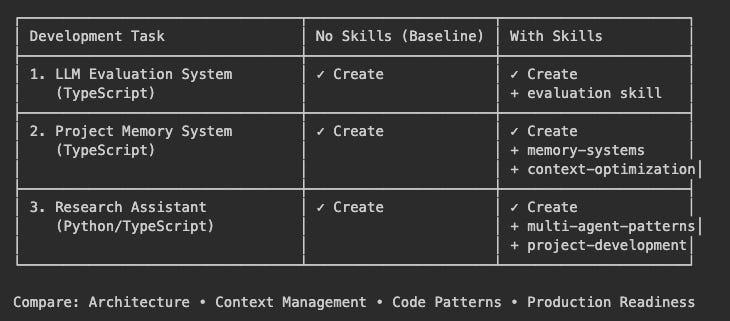
Experiment Design:
Process Flow:

Steps:
Load relevant skills into project rules (or skip for baseline)
Give identical prompts to the agent for each task
Generate implementation summaries for both versions
Compare how skills influence architecture, context handling, and implementation quality
This controlled comparison reveals how context engineering skills guide the agent to apply research-backed patterns automatically, even when using an advanced model like Claude 4.5 Opus.
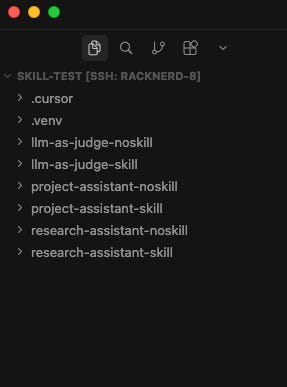
Let’s examine the three cases.
